
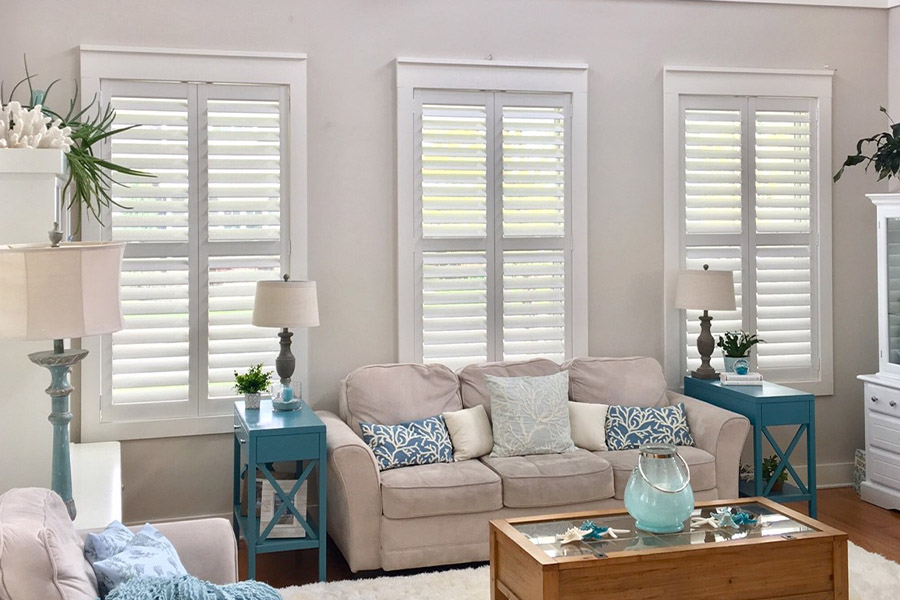
Most window treatment advice was written for four-season climates. Florida is not a four-season climate. Your window coverings face salt air, relentless UV rays, humidity that hovers near 80 percent for months, and afternoon sun that fades fabric in ways a Chicago winter never would. Pick the wrong material and you’ll be replacing it in three years. Pick the right one and it’ll still look sharp a decade from now.
This guide walks you through every real decision: material, style, room, and budget, with a framework built specifically for coastal conditions.
Why Coastal Florida Changes Everything
Before you even look at fabric swatches or shutter finishes, you need to understand what your windows are actually dealing with. The Gulf Coast sun is not gentle. UV intensity along Florida’s west coast is high enough to bleach raw wood, warp uncoated faux materials, and degrade the adhesive backing on cheap roller shades within a single summer.
Humidity compounds that. Solid wood blinds and shutters can expand and contract with moisture swings, which means a wood product that fits perfectly in October might bind in August. That’s not a manufacturing flaw. It’s physics. Any material you choose needs to be rated for high-humidity environments, or you’ll fight warping, mold, and sticking year after year.
Then there’s heat gain. According to the U.S. Department of Energy, windows account for 25 to 30 percent of residential heating and cooling energy use. In a Florida home running air conditioning nine months a year, that’s a real line item on your electric bill, and the right window covering can meaningfully shrink it.
The Sun-First Framework for Picking Materials
Here’s a simple decision framework developed for coastal homeowners: start with sun exposure and work backward to material, then style.
Step 1: Map your window exposures. Walk through your home and note which direction each major window faces. West-facing windows in Florida get punished. They catch direct afternoon sun from May through October and will test any treatment you put on them. South-facing windows get consistent but more manageable light. North-facing rooms are the easiest to work with.
Step 2: Match material to exposure intensity. For west and south windows, your best options are:
- Vinyl and composite shutters, which handle moisture and UV without warping or fading
- Solar roller shades, designed specifically to block UV while preserving your view of the water or yard
- Cellular shades with UV-blocking fabric for rooms where you want insulation alongside light control
For north-facing rooms or interior windows where sun exposure is minimal, wood shutters, woven natural shades, and fabric drapes are all workable. You get more design flexibility where the sun isn’t fighting you.
Step 3: Decide on light control vs. privacy vs. both. These are not the same thing. A sheer shade gives you privacy from outside during the day but goes fully transparent at night. A room-darkening shade handles both. Solar shades block heat and UV but offer almost no nighttime privacy. Know what each room actually needs before you fall in love with a style.
Room-by-Room Breakdown
A single product is rarely right for the whole house. Here’s how to think about it space by space.
| Room | Top Priority | Best Treatment Type | Avoid |
|---|---|---|---|
| Living Room | Light and view | Solar shades or composite shutters | Untreated wood in west-facing rooms |
| Primary Bedroom | Sleep quality and privacy | Room-darkening cellular or roller shades | Sheer-only treatments |
| Kitchen | Moisture resistance | Aluminum blinds, vinyl shutters | Fabric Roman shades near the sink |
| Bathroom | Privacy and humidity tolerance | Composite or vinyl shutters | Anything with fabric backing |
| Sunroom or Florida Room | UV and heat block | Outdoor roller screens, solar shades | Standard indoor fabric treatments |
What Motorization Actually Fixes
Motorized shades sound like a luxury add-on. For a Florida home, they’re closer to a practical tool. Here’s why: when you’re dealing with west-facing windows and afternoon heat spikes, you want those shades closing at 2 p.m. automatically, not after you remember to do it at 4 when the room is already uncomfortable.
Motorized treatments connect to smart home systems and can be scheduled to adjust based on time of day. For a home with hard-to-reach transoms or clerestory windows above the kitchen, they solve an actual access problem, not just a convenience one.
The upfront cost is real, but so is the payoff. Automated shading reduces the work your air conditioning does during peak hours, and in a Florida home where the AC never fully rests, that matters. Consider motorization for any window that’s difficult to reach, any west-facing room you use heavily in the afternoon, and any space where glare is a daily annoyance.
Outdoor Treatments: The Layer Most Homeowners Skip
The best place to block solar heat is before it gets through the glass. Outdoor roller screens and Bahama shutters stop radiant heat at the exterior of your home, which means your interior stays cooler without the AC working harder. This is especially true for screened lanais, covered porches, and sunrooms where standard interior treatments don’t apply.
Bahama-style shutters, which hinge at the top and prop outward at an angle, are also a practical storm prep layer. They’re common across the Caribbean for exactly that reason. On a Gulf Coast property, they serve double duty: shade management and protection before a storm makes you dig out the plywood.
“The window is the weakest thermal link in the building envelope, and the right covering changes the equation more than most homeowners expect.” This consensus from building science researchers aligns with Department of Energy findings that targeted window treatments can meaningfully reduce a home’s cooling load.
The Local Expertise Advantage
Homeowners across the country are investing more in their existing properties than ever before. The U.S. Census Bureau’s 2023 American Housing Survey found that American homeowners spent $827 billion on home improvement projects in the two-year period ending in 2023, an increase of more than $200 billion over the prior survey period. Window and door improvements were among the most common projects in the dataset.
In a market like St. Petersburg, where architectural styles range from Spanish bungalows to new construction waterfront homes, off-the-shelf window treatments rarely fit right, literally or aesthetically. Irregular window dimensions, arched transoms, and sliding glass doors that span entire walls all require precise measuring and custom fabrication. That’s where working with Window treatment experts in St. Petersburg, FL pays off in ways that an online order simply can’t match. A showroom consultation lets you see materials in hand, compare finish samples side by side, and get measurements taken by someone who has installed thousands of units in homes just like yours.
Three Questions to Ask Before You Buy Anything
Before you commit to a style or material, run through these:
- Is this rated for high humidity? Not just “moisture resistant” in marketing language, but actually engineered for sustained humidity. Ask for the spec sheet.
- How is the UV protection rated? Solar shades have an openness factor measured as a percentage. Lower percentages block more heat and UV. A 3 to 5 percent openness factor is right for a room with heavy afternoon sun.
- What does installation include? Precise inside-mount measurements and professional installation make a bigger difference than most buyers expect. A treatment that’s off by a quarter inch gaps on both sides and loses most of its insulating value.
Florida homes aren’t hard to outfit well. They just require a different set of priorities than the generic advice assumes. Start with your sun exposure, match your material to your conditions, and get a professional measurement before anything goes on order. Do those three things and you’ll end up with treatments that look great, perform well, and actually last in the Gulf Coast climate.
