
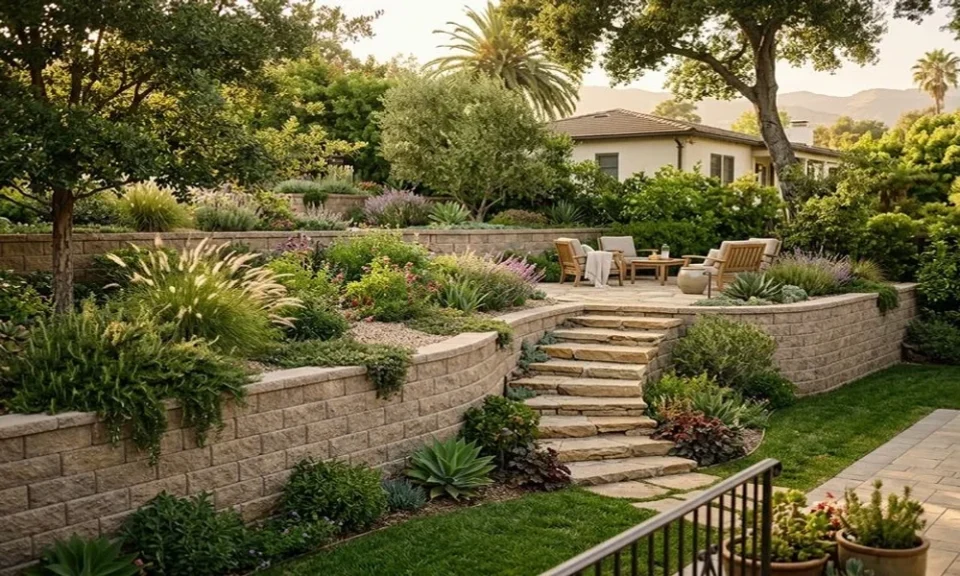
Why Multi-Level Yards Need More Than a Staircase
Steps, retaining walls, and landings can make a sloped yard easier to use, but they need to work together. Consider where people will walk, how water will drain, and which areas need a level surface. Planning those connections early helps avoid awkward routes and isolated sections of the yard.
That is where thoughtful hardscaping changes the equation. The goal is not simply to move from one level to another. The real goal is to shape the terrain so every level has a purpose. With the right combination of steps, walls, and landings, a steep or uneven yard can become organized, functional, and much easier to use day to day.
Jones Outdoors approaches this type of project as a design problem first and a construction problem second. That matters, because the best results come from understanding how people will actually use the yard, not just how it looks on paper. A well-planned transition can turn a difficult slope into a sequence of outdoor rooms.
Retaining Walls Do the Structural Work Before the Style Comes In
Retaining walls are often the quiet foundation of a successful multi-level landscape. Their job is not decorative at first. They hold back soil, reduce erosion, and create stable flat areas where the yard can be used more effectively. Without that structural support, steps and patios can feel like temporary fixes instead of part of a lasting outdoor plan.
Jones Outdoors builds retaining walls to create terraced levels and define outdoor areas. That gives a property more than stability. It creates shape. A single steep slope can become two or three usable zones, each with its own function, such as planting beds, seating space, or an open lawn area. That means a yard can support more activity without feeling crowded or forced.
The Difference Between Holding Soil and Creating Space
A wall that only resists pressure is doing one job. A wall that also establishes a flat, usable terrace is doing two. This distinction matters because many homeowners focus on appearance first and only later realize that a wall needs to support real use. If the wall is too low, placed in the wrong position, or detached from the rest of the layout, it can leave the yard fragmented.
A better approach is to design the wall around the full sequence of movement and function. That is why Jones Outdoors often treats walls, walkways, and landings as one system rather than separate additions. The wall creates the level change, but the surrounding surfaces make that change livable.
Steps and Landings Make the Elevation Change Feel Intentional
Stairs solve access, but stairs alone can feel abrupt. When a yard has multiple levels, the transition works best when steps are paired with landings that give the eye and the body a place to pause. Those intermediate spaces improve comfort and help the overall layout feel deliberate instead of improvised.
Landings are especially useful when a property has several destinations. A step run from a patio to a garden bed feels very different from a wider transition that includes a landing before turning toward a secondary zone. The landing breaks up the movement, improves flow, and can serve as a visual connector between one level and the next.
Well-placed landings can also improve how the yard functions in everyday use:
- They create a safe pause point on longer transitions.
- They make turning corners easier and more natural.
- They can support planters, lighting, or a small visual feature.
- They reduce the feeling that one level is simply stacked on top of another.
The material choices matter as well. Walkways and landings can be built from concrete, flagstone, gravel, or pavers depending on the project goals and the surrounding design. Each option changes the feel of the space. A cleaner modern layout may call for concrete or pavers, while a more natural setting may benefit from flagstone and softer texture.
Materials Should Match the Terrain, Not Just the Look
On paper, many materials seem interchangeable. In a real yard, they are not. The terrain, slope, drainage, and climate all influence which surface will perform best over time. That is why a good design process considers both appearance and durability from the beginning. A beautiful landing that does not handle the site conditions well is a short-term decision, not a strategic one.
Jones Outdoors works with materials such as natural stone, flagstone, concrete, and pavers because different yards need different solutions. A hardscaping choice should support the way the land behaves. If a section sees more foot traffic, a more durable paved surface may make sense. If the goal is to soften the transition into a garden terrace, a more textured material may fit better.
When One Material Is Not Enough
The strongest projects often use more than one material in a controlled way. For example, a retaining wall may anchor the edge of a terrace, while pavers form a clean landing and flagstone creates a more organic path to a lower level. This approach avoids monotony and gives each zone a distinct role.
Combined material use also helps with hierarchy. Not every surface in the yard needs to compete for attention. Some elements should support movement. Others should define a destination. When the material palette is used with discipline, the whole space feels more intentional.
For homeowners comparing options, projects involving hardscaping services in Weber County often need this kind of layered thinking because slopes, soil movement, and weather exposure can affect performance. The best outcomes come from matching structure and surface to the real conditions of the site, not to a generic template.
Better Yard Flow Starts With How People Move Through the Space
A well-designed multi-level yard should guide movement naturally. People should know where to walk, where to pause, and which areas are meant for gathering or planting. If that flow is missing, even a nicely finished yard can feel awkward. You may have technically solved the slope, but you have not yet solved the experience.
This is where a skilled designer can make a visible difference. Jones Outdoors uses a structured process that includes consultation, design with 3D renderings, implementation, and integration with contracting specialists when needed. That kind of process matters because elevation projects often involve more than one trade or more than one design decision. A coordinated plan reduces the chance that steps, walls, and surfaces are built in isolation from each other.
A strong layout typically addresses three questions at once:
- Where should the eye travel first?
- Where does the body need support or pause?
- Which areas should feel open, and which should feel defined?
If those questions are answered early, the final project tends to feel calmer and more usable. The yard stops behaving like a slope with obstacles and starts behaving like a sequence of outdoor destinations.
What Strong Operators Do Differently on Complex Yards
The difference between a basic hardscape and a well-resolved one is usually not a single dramatic feature. It is the quality of the decisions underneath the surface. Strong operators think through transitions, drainage, material sequencing, and the relationship between walls and walkways before a single stone is set.
They also communicate visually. 3D renderings are useful because they let a homeowner see how the levels, steps, and landings will relate to one another before construction begins. That reduces guesswork and helps refine the layout while changes are still easy to make. Material samples matter for the same reason. A stone that looks right in isolation may feel too heavy or too light once it is placed next to the house, a patio, or a planting bed.
Jones Outdoors works on Utah properties where terrain and seasonal conditions need to be considered. That local perspective is important in hardscaping, where terrain and climate are not minor details. They are part of the design brief.
The Long-Term Payoff Is Usability, Not Just Visual Improvement
The most effective multi-level landscape projects are not the ones that simply look finished. They are the ones that make the property easier to live with over time. A yard with terraced levels, stable walls, and clear transitions is easier to maintain, safer to move through, and more flexible for future use.
That is the real value of connecting different yard levels well. You are not just solving for slope. You are creating a property that works harder for the people who use it. Done properly, the result feels natural rather than engineered, even though it depends on careful planning and disciplined construction.
For homeowners ready to turn uneven ground into a more practical outdoor space, Jones Outdoors offers the experience and design clarity to do the job with purpose. Start with a conversation, study the site carefully, and build the transitions as a system rather than a series of fixes.
