
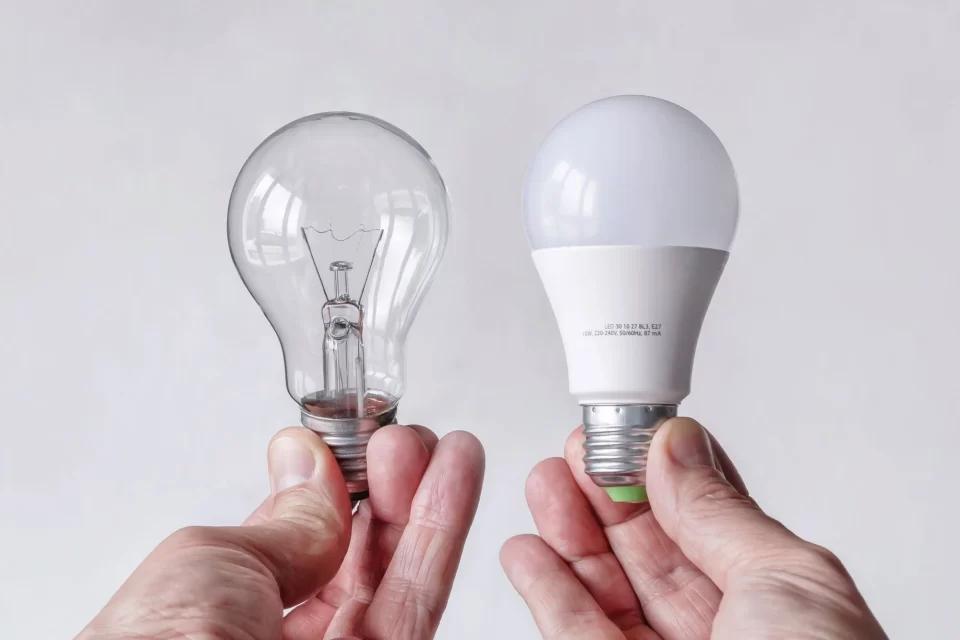
Lighting plays an important role in our daily lives: whether at home, in offices, or on the streets. Over the years, lighting technology has evolved from traditional incandescent bulbs to more energy-efficient options like CFLs and LEDs. Each type of bulb has its own advantages and drawbacks in terms of brightness, energy use, and lifespan. Understanding how they differ can help you choose the best lighting solution for your needs.
Let’s take a closer look at incandescent, CFL, and LED light bulbs, how they work, and which one offers the best value for your home or workspace.
Incandescent Bulbs
Incandescent bulbs are the oldest type of electric light and have been used for over a century. They pass electricity via a thin tungsten filament inside a glass bulb. Upon heating, the filament glows and produces light.
These bulbs are known for their warm, pleasant light that closely resembles natural sunlight. However, they are highly inefficient because most of the energy they use is converted into heat rather than light.
While they are inexpensive and provide instant brightness, they consume more electricity and have a short lifespan, typically around 1,000 hours. They also tend to get hot quickly, which makes them less suitable for long hours of use or enclosed spaces.
CFL Bulbs
CFL, or Compact Fluorescent Lamp, is a more energy-efficient version of the traditional fluorescent tube light. These bulbs work by sending an electric current through a tube containing argon gas and a small amount of mercury vapour. This process produces ultraviolet (UV) light, which then reacts with a fluorescent coating inside the tube to create visible light.
CFL bulbs consume about 1/5th to 1/3rd of the electricity that incandescent bulbs do and last much longer, typically around 8,000 hours. They come in various colour temperatures, from cool white to warm tones, making them suitable for both homes and offices.
However, CFLs have a few drawbacks. They take a few seconds to reach full brightness, and they contain mercury, which makes disposal slightly more complicated. They’re also more fragile than LEDs and may flicker when the voltage fluctuates.
Still, for many years, CFLs were a popular choice for energy-conscious users before LED light bulbs became more affordable and accessible.
LED Bulbs
LED (Light Emitting Diode) bulbs are the most advanced and efficient lighting technology available today. Unlike incandescent and CFL bulbs, LEDs don’t rely on heating or gas reactions to produce light. Instead, they generate light when electricity passes through semiconductor materials inside the bulb.
LED bulbs offer numerous benefits:
- They consume up to 75% less energy than incandescent bulbs.
- Their lifespan ranges from 15,000 to 50,000 hours, depending on usage and quality.
- They emit very little heat, making them safe and cool to touch.
- They turn on instantly, without any flicker or warm-up time.
Another big advantage of LED technology is its versatility. From LED candlelight bulbs that add elegance to dining areas to warm LED light bulbs that create a cosy home atmosphere, there’s a type of LED for every need.
Modern LED light bulbs also come in various colour temperatures, beam angles, and shapes, making them ideal for everything from reading lamps and study rooms to decorative lighting and outdoor setups.
Key Differences Between Incandescent, CFL, and LED Bulbs
Let’s compare these three types of bulbs based on important factors like energy efficiency, environmental impact, lifespan, and heat emission.
Energy Efficiency
When it comes to saving electricity, LED bulbs are clear winners. They use a fraction of the power required by incandescent bulbs to produce the same amount of brightness.
- Incandescent bulbs: Least efficient; waste around 90% of energy as heat.
- CFL bulbs: More efficient than incandescent but still lose some energy during gas reactions.
- LED light bulbs: Most efficient, converting almost all energy directly into light.
For Indian households where energy costs are rising, switching to LEDs can reduce monthly electricity bills significantly.
Environmental Impact
Energy efficiency directly affects the environment because lower energy use means fewer carbon emissions.
- Incandescent bulbs have a large carbon footprint due to high power consumption.
- CFL bulbs are better but contain mercury, which requires careful disposal to prevent pollution.
- LED bulbs are the most eco-friendly, containing no toxic materials and lasting much longer, which reduces waste.
In short, LEDs are not only better for your wallet but also for the planet.
Lifespan
The difference in lifespan among the three types is remarkable:
- Incandescent: Around 1,000 hours
- CFL: Around 8,000 hours
- LED: 15,000 to 50,000 hours
LEDs clearly stand out as the longest-lasting option. For homes or businesses that require continuous lighting, this means fewer replacements and less maintenance over time.
Heat Emission
If you’ve ever touched a glowing incandescent bulb, you know how hot it can get.
- Incandescent bulbs release most of their energy as heat.
- CFL bulbs emit moderate heat but stay cooler than incandescent ones.
- LED bulbs remain cool, even after hours of operation, making them ideal for enclosed or air-conditioned spaces.
Lower heat emission also means LED light bulbs are safer to handle and help keep indoor temperatures comfortable.
Lighting the Future
As lighting technology continues to evolve, the shift toward LED light bulbs is not just a trend; it’s a smart and sustainable choice. The versatility and efficiency of LEDs make them suitable for every setting.
While incandescent and CFL bulbs had their time, LEDs represent the future of illumination: combining brightness, longevity, and environmental care in one package.
