
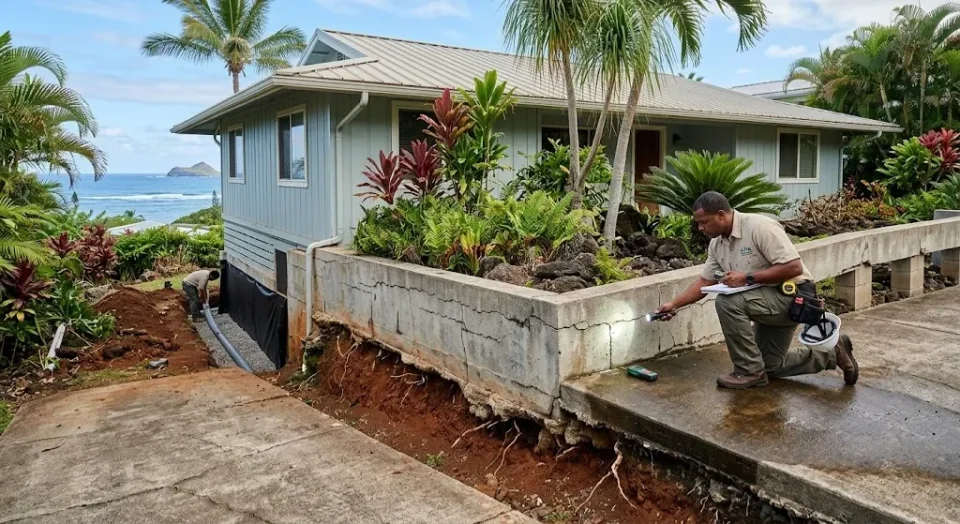
Your house has a birthday, and that birthday matters more than most Honolulu homeowners realize. The year a home was built shapes what materials went into its foundation, what soil conditions were present when crews broke ground, and how many decades of tropical moisture and geological movement the structure has absorbed since. Two homes on the same street can face completely different foundation futures based on a decade of difference in their construction year.
This is not abstract. Honolulu sits on some of the geologically youngest and most variable land in the country. Coastal alluvium, reclaimed fill, and moisture-sensitive clays show up side by side across Oahu’s neighborhoods. Add to that the sheer age of the local housing stock, and you have a city where construction era is one of the most useful lenses for predicting where foundation trouble is likely to appear next.
What the Numbers Say About Hawaii’s Housing Stock
Most people assume Hawaii’s homes are relatively new, built during the tourism and post-statehood boom. The reality is older. According to U.S. Census Bureau data, the median construction year for homes in Hawaii is 1980, meaning half the state’s housing stock is at least 45 years old. In Honolulu’s older residential corridors, neighborhoods like Kaimuki, Manoa, and Moanalua, you’ll find clusters of homes built in the 1950s and 1960s that have never had their foundations professionally evaluated.
Forty-five years is a long time for a foundation to absorb cyclic wetting and drying, root pressure, and the slow vertical movement that Oahu’s subsurface geology produces. The question is not whether movement has occurred in those homes. It almost certainly has. The real question is whether it has crossed from normal settling into differential settlement, which is the kind that actually damages a structure.
A Decade-by-Decade Risk Framework
Not all eras carry equal risk. Construction practices, code requirements, and soil preparation standards changed meaningfully across the decades Honolulu grew into a modern city. Here is a practical way to think about it.
| Construction Era | Primary Foundation Risk | Common Contributing Factor |
|---|---|---|
| Pre-1950 | Highest | Minimal compaction standards, post-and-pier construction on unengineered fill |
| 1950s to 1960s | High | Rapid Oahu suburban expansion onto coastal plains with silty clay soils |
| 1970s to 1980s | Moderate to High | Improved codes but widespread development on valley fill and reclaimed land |
| 1990s to 2005 | Moderate | Better engineered fills, though expansive clay zones still problematic |
| Post-2005 | Lower (but not zero) | Modern geotechnical standards; risk remains near old fill or coastal sites |
The pre-1950 category deserves particular attention. Honolulu’s oldest residential neighborhoods were often built on whatever grade was available, with post-and-pier construction that left the structure’s weight distributed across shallow, widely spaced contact points. When the soil under one of those piers softens or compresses unevenly, the whole floor system tilts. That is classic differential settlement, and it tends to compound quietly for years before a homeowner notices the door that no longer latches.
Why Oahu’s Subsurface Makes Age Matter More
In many mainland cities, a 50-year-old home sits on bedrock or stable glacial till. Honolulu is different. A U.S. Geological Survey study of Oahu’s groundwater and geology documents that the island’s coastal plain soils consist primarily of silty clays and alluvial deposits intermixed with marine sediments, soil types known for their compressibility under load and their sensitivity to groundwater fluctuation. The same study identifies the scale of Oahu’s subsurface groundwater system, with basal springs alone estimated to discharge roughly 100 million gallons daily.
That groundwater is not sitting still. It rises and drops seasonally. When it rises, it softens compressible clay layers beneath older foundations. When it drops, those same layers can consolidate unevenly, pulling the soil away from the foundation base. A home built in 1962 in Moanalua, sitting directly above one of these coastal alluvial deposits, has endured roughly six decades of that cycle. The cumulative effect shows up as slope in the floors, gaps above baseboards, and cracks radiating from window corners.
Secondary settlement, which geotechnical engineers define as the long-term creep of soil particles under constant load, plays out over decades. A 1960s home may still be experiencing measurable movement today from original construction loads, particularly if it sits on organic-rich or saturated clay.
The Scenario That Catches Owners Off Guard
Here is where things get expensive. A homeowner buys a 1965 Kaimuki home, moves in, and notices only minor cosmetic issues. A few hairline cracks above doorways, a kitchen door that sticks in summer. They chalk it up to Hawaii’s humidity. Five years pass. They repaint, maybe regrout the bathroom. They do not have the foundation looked at.
By the time a licensed structural contractor does come out, often prompted by a sale inspection or a cracked tile floor, the differential settlement has progressed well past the point where surface repairs will hold. What started as two inches of uneven settlement is now approaching four inches at one corner. The cost to remediate goes up sharply once movement has been ongoing long enough to stress the stem wall, the sill plate, or the slab itself.
Getting a foundation assessment early, at the first door or window that binds unexpectedly, is almost always cheaper than waiting. The Honolulu foundation settlement repair specialists at Structural Systems Inc. use deep helical pier and grouting systems specifically designed for the soil conditions found across Oahu, tools that can restore a settled structure to a level condition without the disruption of full excavation.
What Hawaii’s Housing Demand Tells Us About the Stakes
Honolulu homeowners have strong financial incentive to protect their properties. The Hawaii Department of Business, Economic Development and Tourism’s 2024 Housing Demand repa ort tracks steady growth in Hawaii’s occupied housing units from 1900 through 2020, reflecting a housing stock that is continuously strained and carries high asset values across every price tier. With median single-family home prices in Honolulu well into the six figures, an unresolved foundation problem is not a cosmetic issue. It is a direct threat to property value and mortgage insurability.
Buyers’ inspectors know what differential settlement looks like, and they flag it. A flagged foundation on a Honolulu listing creates negotiating leverage for the buyer, requires disclosure, and in some cases kills a deal entirely. Selling a home without addressing settlement is almost always the more expensive path.
Geotechnical engineers consistently note that foundation settlement in Honolulu’s coastal neighborhoods is not a question of if but when, given the combination of compressible alluvial soils, seasonal groundwater fluctuation, and aging construction standards from the mid-20th century build-out of Oahu.
A Practical Checklist for Owners by Home Age
Use your home’s construction year as the starting point, not the endpoint, of your evaluation.
- Pre-1970 homes: Schedule a professional foundation inspection now if one has not been done in the past five years. Look specifically at any area of the structure that overhangs or is close to grade.
- 1970s to 1980s homes: Walk every interior door and window twice a year. Note any new sticking or binding. Check your slab or crawlspace for visible cracking trends.
- 1990s to early-2000s homes: Review original geotechnical reports if the builder provided them. Know whether your lot involved fill. Fill sites behave differently from natural grade sites regardless of code compliance at the time.
- Post-2005 homes near the coast or in valley fills: Do not assume modern construction eliminates risk. Groundwater and soil variability still apply. Monitor for early signs and act on the first one.
The year on your building permit is a starting clue, not a verdict. Two identical 1970 homes in Honolulu can have completely different foundation trajectories based on lot position, drainage, and the quality of original compaction. But construction era narrows the field and tells you where to focus attention first.
Your home’s age is one of the most honest things it can tell you. Pay attention to it before the floors start doing the talking.
